Moisture Minder Technology

The Moisture Minder Technology delivers unparalleled accuracy,
making it the most reliable method for in-line polymer moisture control

How Moisture Minder Technology Works

First of all, some basics:

Accuracy and precision are not the same. A sensor may show extremely good precision when set up on a stationary target but could be very non-linear and not accurate.

precision_image

Precision - The degree of reproducibility
of measurement

accuracy_image

Accuracy - How close the measured value is to the actual (absolute) value
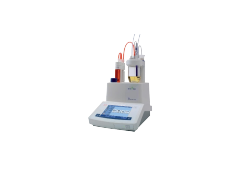
Measurements in lab and measurements in-line presents some differences, and they have both pro and cons.
They just serve different purposes.

Laboratory devices (direct method)

Laboratory devices have a higher accuracy and usually requires special expertise by technologist.
Sample collection methodology must be very accurate, as errors due to this practice may compromise the measurement results.
Lab device sample is normally 3-20 gr which is not representative of ongoing production (hundreds Kg)

In-line Sensors (indirect method)

A calibration against a known moisture amount is required. This extra, offers the speed of obtaining a moisture measurement (seconds instead of minutes), and allows a quick fix of the production process.
In-line devices do not require any specific knowledge of physics/chemistry of materials to control.

Different methods cannot be compared!

Direct methods

They remove the water from the product (by drying, extraction, etc.) then measuring the amount of water by weighing or titrating. Direct methods provide the most accurate results but are usually labor intensive and time consuming. Some examples include Karl Fischer, thermogravimetric analysis, manometric and gas chromatography.

Indirect methods

They do not remove the water from the sample. Instead, they involve measuring some property of the sample that changes as moisture content changes. These methods require calibration to a primary or direct method and their accuracy is limited by the accuracy of the primary method.
Further complicating the process of measuring moisture content is that one measurement method does not necessarily provide the same results as another.
Even so-called direct measurement methods do not provide consistent results. Any method that requires heating the sample can lead to the loss of volatiles or decomposition or chemical reaction of the sample or simply or measure how much is evaporated during the measurement, which is not necessarily all the water content of the sample. For example, if chemical volatiles are present in a sample or if the sample decomposes while being dried, a Karl Fischer analysis, which is not susceptible to volatile loss or decomposition, will give different results than a loss-on drying analysis. On other way around, some chemicals additives may react with titration producing different results.
e.g. time/temperature combination usually results in variable values of moisture contents.

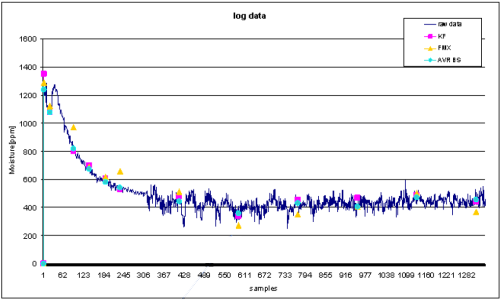
The graph shows a comparison between the continuous measurement and the different sampling performed with Karl Fisher and Aboni Hydrotracer Lab Analyzers.
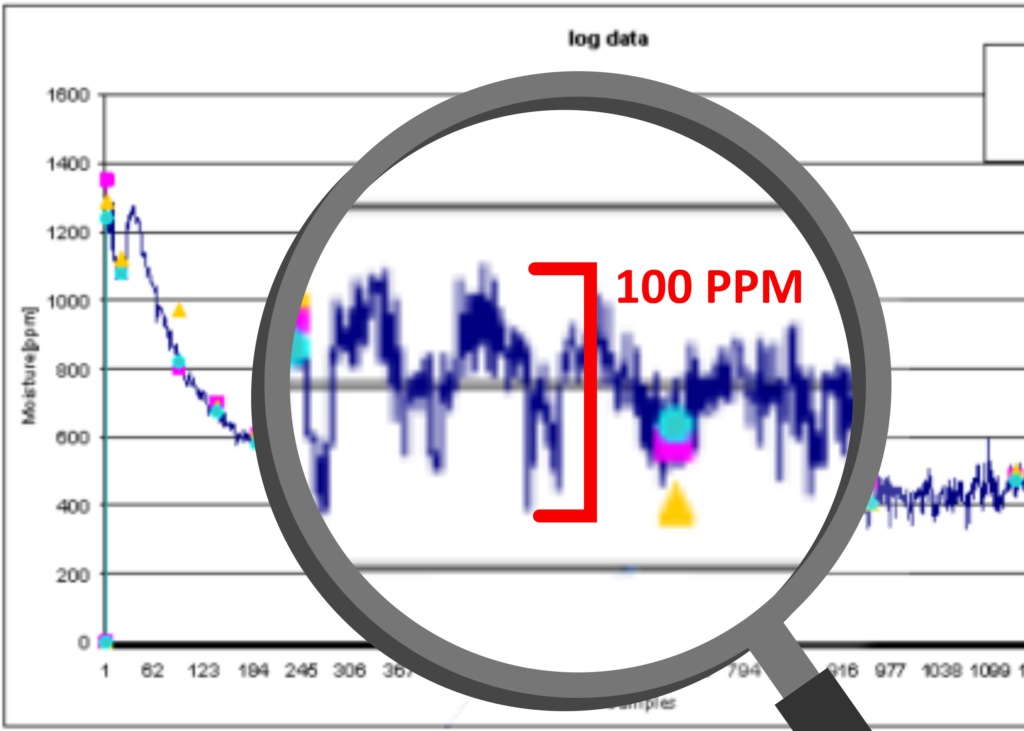
The graph shows that during drying process there are several variations in moisture content up to 200 ppm.

Even if the average of the values intercepts the laboratory analysis values, as can be seen from the figure, a few seconds before and after sampling, they show variations of about 180 ppm

focus
How it works:

Basic Principle

The relative permittivity is a parameter that indicates the relative charge storage capability of dielectrics compared with free space.
Moisture measurement technique is based upon the relatively high dielectric permittivity (commonly called DIELECTRIC CONSTANT) of water (80-35) in comparison to the dielectric properties of the polymers (2-5).
The variation of water content within the product, would result in a variation in the combined dielectric constant which would then be measured by monitoring the changes in the dielectric signal.
The technology used, provides the ability of the sensor to separate real (capacitive) and imaginary (conductive) components of dielectric permittivity.

Bryscan Sensors - Moisture Minder Technology

The patented moisture sensors developed by BRY-AIR PROKON mainly comprises two components: the fully-differential sensing capacitor and the high-precision readout electronics. The fully-differential sensing capacitor detects the changes of moisture based on the edge/fringe effect as shown in Figure.
A special PTFE insulator is used to maximize the stability of the reference capacitance
Moisture Minder Technology

Dielectric theory: How it works

In a heterogeneous medium:

  • Volume fraction of any constituent affects total (bulk) dielectric permittivity
  • Changing any constituent volume changes the total dielectric
  • Changes in water volume have the most significant effect on the total dielectric
Material Dielectric
Permittivity
Air 1
Polymer 2-5
Water 80-35

Generalized dielectric mixing model

\( \varepsilon = \chi \varepsilon_{Fw} + \chi \varepsilon_{Bw} + \chi \varepsilon_{A} + \chi \varepsilon_{bm} \)

ε = Apparent Dielectric Permittivity

χ = Volume fraction

Fw = Free Water (Surface Moisture)

Bw = Bound Water (Moisture Content)

A = Air

Bm = Bulk Material
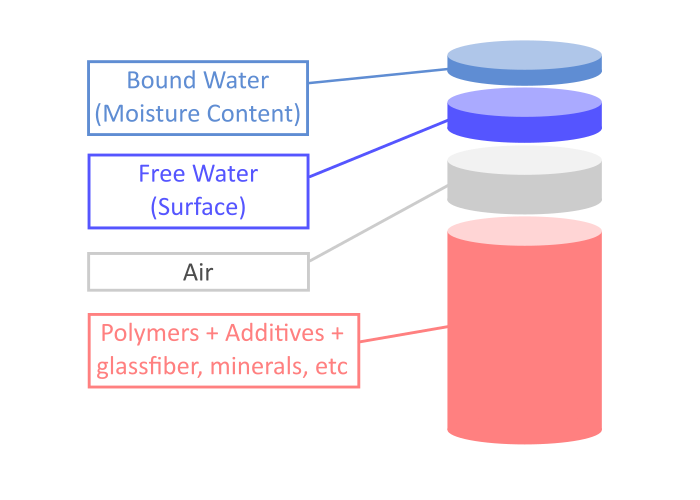
Dielectric Measurement

Dielectric measurement can be sometime very difficult as some polymers blend contains additives, Glass fiber, mineral etc. The measurement of apparent permittivity in a polymer can be summarized as shown below.

Factors affecting WC accuracy

Sensor Accuracy

Sensor’s ability to measure dielectric permittivity accurately.
Sensor accuracy: +/- 2 fF (10-15)
Resolution 0.1 fF
Linearity: 0.01% in the range 20-140°C
Linearity: 0.03% in the range 140-170°C
Linearity: 0.07% in the range 175-200°C

Correct installation

The sensor should be installed at the best sampling position in your production system.
To avoid source of errors the sensor should be always fully filled with material.

Temperature Accuracy

Permittivity of water and polymers are strictly related to temperature.
Sensor’s ability to measure temperature accurately.
Resolution: 0.1°C, accuracy: ±1.7°C

Errors from ε to θ (Permittivity to Moisture content)

Relationship between dielectric permittivity and WC depending mainly on generalized dielectric mixing model:
• εb Bulk permittivity (sensor accuracy)
• ρb Bulk density
• εr Permittivity of fillers (e.g. glass fiber)
• ρs density of the granules
• εw Permittivity of water
• εα Permittivity of air

\[ \theta = \frac{\varepsilon_b^{\alpha} + (1 - \varepsilon_r^{\alpha}) \rho_b \frac{1}{\rho_s} - 1}{\varepsilon_w^{\alpha} - 1} \]

Effect of bound water on accuracy

Water that is “bound” to polymer chain, has lower apparent permittivity than “free” water.
All the polymers, in granule, have also different dielectric behaviours depending on whether they have been dried or not.
During the drying, process chemical phenomena occur, mainly due to the thermal agitation of the molecules that make the undried material dielectrically different from a dried product.
In some temperature regions (e.g. glass transition) the dielectric measurement of moisture content may be completely incorrect.

Effect of bulk density on accuracy

Bulk density of polymers granules varies (0,5 to 0,8).
This represent +/- 2% error of the measurement, however change in bulk density, even if corrected through an equation cannot exceed 10%, because it means a great reduction of the dielectric constant, especially when it comes to moisture content below 1000 ppm.

Main Takeaways

The sensor is able to detect even small quantities of water, which for a polymer without additives is about 25-30 fF / ppm WC.
However, it must be considered that accuracy and precision depend on too many factors and as explained in the previous pages, the calibration against lab instruments, does not allow the absolute measurement of the quantity of water content.
Many water molecules remain inside the granule, a simple test is done by redoing the measurement with the same sample; the value of zero ppm is hardly reached.
The inline sensor, however, is able to provide a continuous measurement of the material, reducing costs and, above all, rapidly intervening on the production, both automatically and through operator actions.

Recognized Value

Moisture Minder Technology

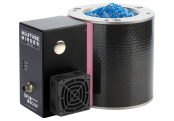
Our Moisture Minder sensor provides a precise, continuous, and in-line measurement of moisture content in polymer materials, specifically designed for high-demand environments such as plastic injection molding and drying systems. This system can be seamlessly integrated at critical points in the production line, including the material entry in injection molding machines or below dryers, ensuring constant control over material quality and process consistency.

Tell us what you need


We’ll help you find what’s right for you

Fill The Form